Photographing a reception in a rented hall
What to ask a venue before you accept a reception job, how to light a windowless banquet room, and how to run coverage from set-up to the last dance.
Ask the venue for the room plan, the ceiling height and the dance floor dimensions before you accept the job. Then walk the room yourself, in the afternoon, with the house lights on and off. The photographs you will make are decided by those three things, not by your camera.
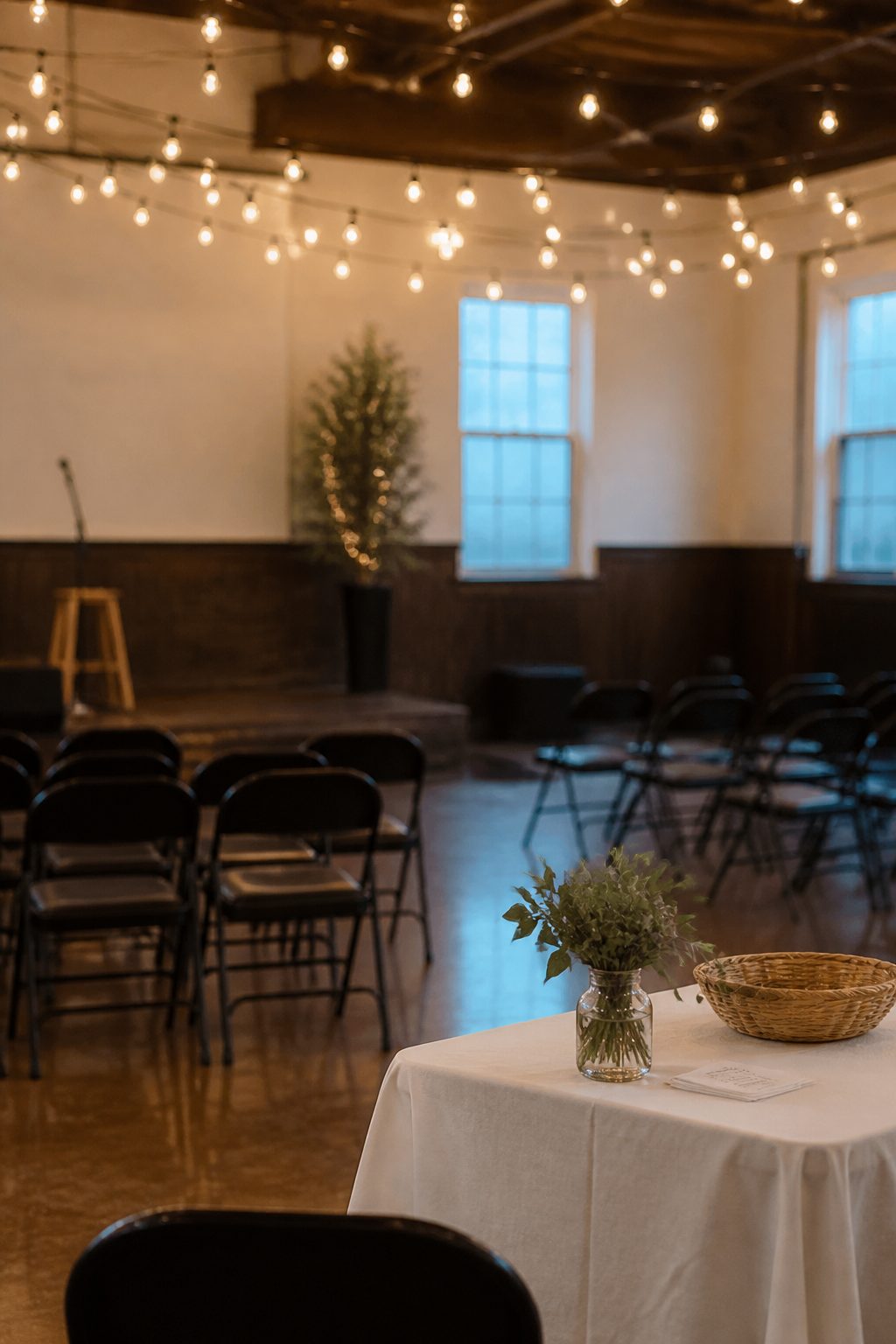
A reception is a documentary job with a fixed clock. You cannot move the room, so you read it first.
What should a photographer ask a venue before accepting a reception job?
Start with the plan. Ask for a scaled drawing, not a sketch on a napkin, and ask which rooms are in use and which walls are movable. A hall that seats 400 on three levels is not one room. It is a banquet floor, a second room and a lower level, and the guests will move between them all night. You need to know where the stairs are before you need to run down them.
Then ask the questions that decide your lighting and your feet.
- What time can I get in, and is the room empty when I do?
- How many amps are on the wall circuits, and where are the outlets?
- What is the ceiling height, and what hangs from it?
- How big is the dance floor, and what is it made of?
- Is there a raised stage, and who controls its lights?
- Where does the caterer set up, and where do the bars go?
- Is there a service corridor I can use without crossing the floor?
- What is the parking situation for my second shooter and my car?
Ask for the venue's own rules in writing. Some halls require a certificate of insurance from vendors. Some restrict where you can tape a cable. Some have a house sound system and a house lighting board, and the person who runs them is not always the person who booked you. Get that name and number.
If you are new to the West Side, read how a room is chosen and run before you bid the job. A magazine that covers choosing a banquet room on this side of Cincinnati will tell you what a family is comparing when they tour, which is usually the same list you are comparing. Capacity, dance floor, kitchen access, parking, cost per guest. Knowing what they were sold tells you what the night is supposed to look like.
How do you work the light in a banquet room with no windows?
You stop looking for daylight and start building your own. A windowless room is not a problem. It is a room with a fixed colour temperature and no surprises, and that is easier than a tent.
Measure the house light first. Most banquet rooms run warm, somewhere around 2700 to 3200 Kelvin, and the chandeliers are not all the same age. Set your white balance by shooting a grey card under the actual house lights, not under your flash. Then decide whether you are matching the room or overriding it. Matching the room keeps the ivory linen and the brass looking like themselves. Overriding it makes every frame look like a different wedding.
Bring light you can shape. Two small strobes on stands, bounced into a white ceiling if the ceiling is low enough and white enough, will carry a toast. If the ceiling is dark or very high, bounce into a wall or use a bare reflector behind you. Keep one light on a bracket for the aisle and the first dance, and keep it low. A single hard source from the camera position flattens a room. A source off to the side, even eighteen inches, gives faces a cheekbone.
Watch the ceiling for what it does to your colour. A walnut ceiling eats light. A white ceiling returns it. A ceiling full of brass fixtures returns it in patches, and those patches move when the house lights dim. Shoot a test frame at every lighting change: cocktail hour, dinner service, toasts, first dance, last dance. The house will change the room four or five times in one night, and each change is a new white balance.
Then work the dark. When the house lights go down for the first dance, do not chase the room with flash. Let the dance floor go dark behind the couple and light them from one side. The guests at the edge of the floor will be silhouettes, and that is the picture. A windowless room at full dark, with one source, is the most controllable light you will get all year.
How is the coverage of a reception day organised from set-up to the last dance?
Build the day backwards from the last dance, then forwards from the room.
Arrive before the guests. Photograph the empty room: the tables set, the cake in place, the dance floor clean, the stage before anyone stands on it. Those frames take twenty minutes and they are the ones the family uses for the album's opening spread. They also give you your exposure for the night.
Then the arrivals. Cocktail hour is a wide shot and a lot of small ones. Work the room edges, not the centre. People at the bar and at the door are relaxed. People in the middle of a room know they are being photographed.
Dinner is the quiet stretch. Use it to eat, to check your cards, and to shoot the room from the back at a long focal length. Toasts come next, and toasts are the one part of the night where you cannot miss. Know where the speaker will stand before they stand there, and know what is behind them. A speaker against a bright wall is a silhouette. A speaker against a dark wall is a portrait.
The dance floor is the last third of the night and it is the part that runs long. Stay on your feet, keep one light on the bracket and one on a stand at the edge of the floor, and shoot through people rather than around them. The best frames at a reception are usually made from inside the crowd, at close range, with the room dark behind.
Finish with the room again. The last dance, the last few guests, the staff stacking chairs. A reception has a beginning and an end, and the end is the part nobody else photographs.
What changes when the hall is a rented room and not a venue you know?
Everything you cannot see. A hall you have never worked has a different load-in, a different sound system, a different person at the door. Ask for a walkthrough at the same hour as the event, not at noon. Light at 6 p.m. in November is not light at 6 p.m. in June, and a room with no windows still changes when the house dims for dinner.
Ask who else is in the building. A rented hall may have two events on two floors, and the second one has its own DJ and its own schedule. Know where the noise comes from and where the other party's guests will walk.
Ask about the end of the night. When does the music stop, when do the lights come up, and how long do you have after that? A hall that holds 400 people empties slowly, and the frames of a room coming apart are worth staying for.
What do you bring that the room does not have?
Grip tape, a small step stool, a grey card, spare batteries, and a plan for the one thing that always fails. In a rented hall, that is usually power. Bring a heavy extension cord and know which outlet it goes into before the caterer takes it.
Bring a second body with a fast prime for the dark. Bring a cloth to clean a lens that will get touched. Bring a copy of your insurance certificate, because someone will ask.
And bring the questions. A photographer who arrives with a list of questions reads as a professional to the venue, and the venue will treat you like one for the rest of the night. That is worth more than any lens.