Editorial photography in San Diego: who commissions it, and what the light does
A coastal city at 32.7 degrees north, with the ocean to the west and a national border to the south. Two weather systems, opposite in character, set the look of most outdoor assignments here. Knowing which one you are working in is worth more than any lens.
- Assignment
- Southern California
- Revised 20/08/2026
Editorial photography is defined by the use, not by the subject or the fee. A picture is editorial when it runs to inform: alongside reporting, in a feature, in an annual review, in a piece of non-commercial storytelling. The same frame becomes advertising the moment it is used to sell something, and it is priced and released differently. That distinction runs through every page in the assignment section.
Who commissions editorial pictures in the region
San Diego is the second-largest city in California and the anchor of a county of roughly three million people. The commissioning base is broad rather than deep, which is the usual shape of a regional market: fewer national titles, more institutions that publish.
- News. The metro daily, the San Diego Union-Tribune, plus the nonprofit newsroom Voice of San Diego and a set of neighbourhood and community papers.
- City and lifestyle magazines, which buy portraits, food, interiors and travel features, and which set most of the region's rate expectations.
- Institutional communications. Universities, hospital and health systems, research institutes and museums all publish magazines and annual reports and commission editorially, not commercially.
- Trade press, heavily weighted toward the county's two large employers by sector: defence and life sciences.
- Wire services and syndication, which cover the border, the port and the Navy presence. How that work is credited and filed is covered on the page about wire credits and caption discipline.
Working definition
Editorial use: publication whose purpose is to inform, comment or report. In the United States, a model release is generally not required, because the image is not being used to imply endorsement. That is a rule about publication, not about behaviour on location. See consent and releases.
The marine layer, or why the coast is often grey at ten in the morning
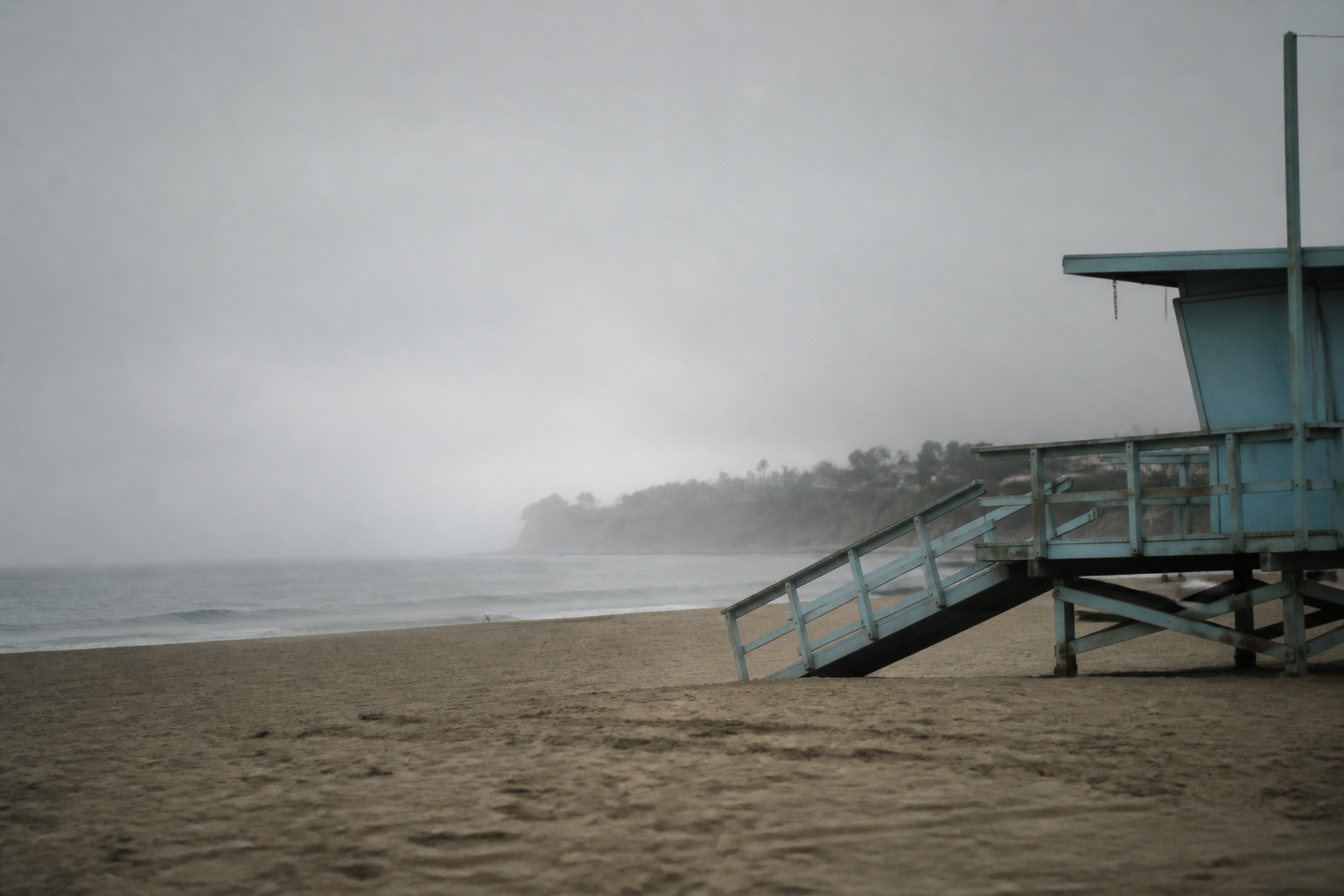
The California Current runs cold down this coast. Air sitting over it cools, holds moisture, and gets trapped beneath a temperature inversion, warmer air above colder air. The result is a shallow deck of low stratus cloud that pushes inland overnight and burns off through the morning as the land heats.
Locally the phenomenon has its own vocabulary. May Gray and June Gloom describe the late spring and early summer weeks when the deck is most persistent and can sit on the beach all day while communities ten miles inland are in full sun.
For a photographer this is a gift and a trap in equal measure.
- The gift: soft, even, shadowless light with no colour cast to fight. Portraits, group shots and anything with faces get easier. You can shoot at eleven in the morning and it looks like an overcast six.
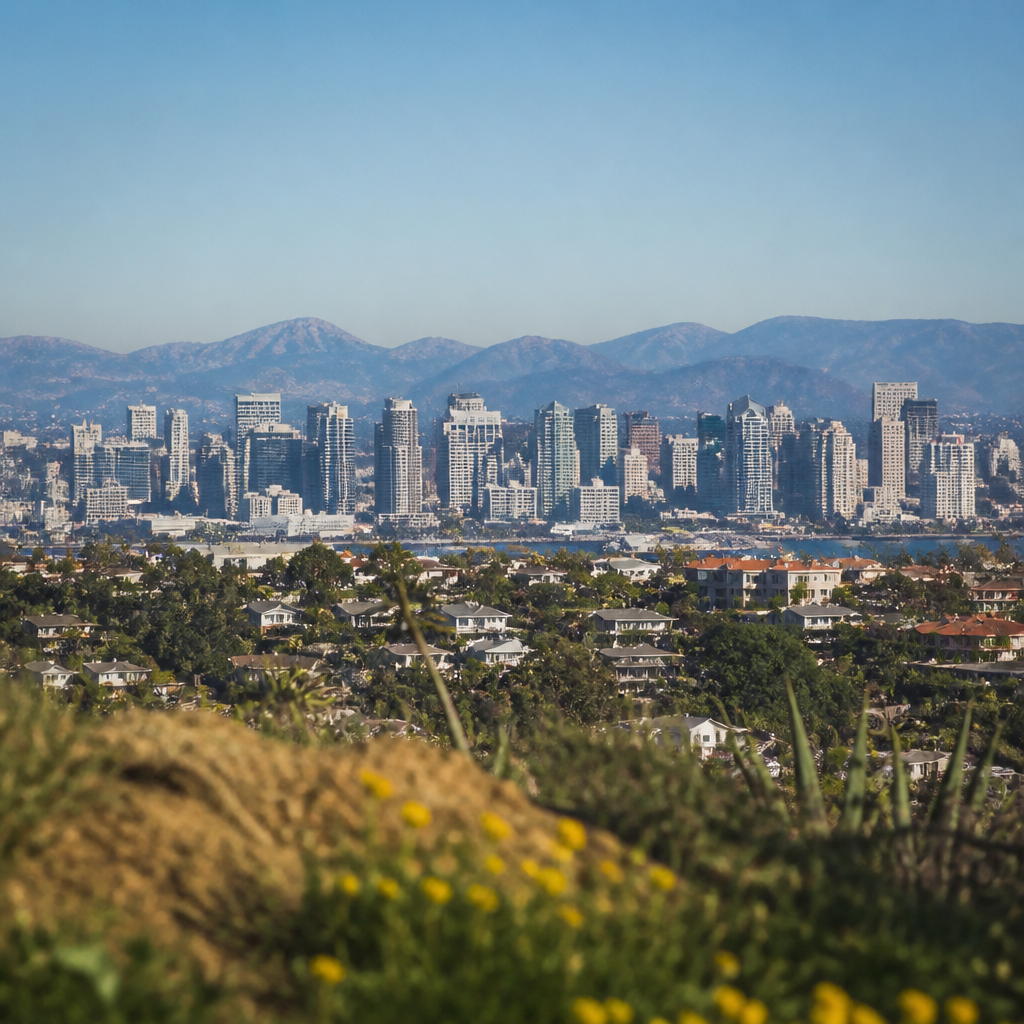
- The trap: flat skies, no modelling on landscape, and a horizon that vanishes into grey. Wide establishing frames die in it. If your assignment needs a skyline or a coastline with depth, the marine layer will cost you the picture.
- The practical rule: the deck usually clears inland first and from the north. Ten miles east can be a different day. Build that into the call sheet rather than the weather app.
Santa Ana conditions: the opposite problem
Santa Ana winds are dry, often warm, and blow offshore, from the interior deserts toward the coast, in the reverse of the usual sea breeze. They are most common from autumn into winter. They scrub the haze out of the air completely.
Under Santa Ana conditions the region looks like a different place: visibility runs for tens of miles, the mountains appear from the coast, shadows are hard-edged and black, and low sun goes intensely warm. It is the best light of the year for landscape and architecture and the worst for a portrait at noon. It also raises fire risk sharply, which changes what is safe and what is appropriate to photograph.
| Period | Typical condition | Consequence on location |
|---|---|---|
| May to June | Persistent marine layer, grey mornings, often grey all day at the beach | Excellent for faces, useless for skylines. Move inland for contrast. |
| July to September | Burn-off by mid morning, high hard sun, humid haze in the afternoon | Shoot early or late. Midday needs open shade or fill. |
| October to February | Santa Ana episodes, exceptional clarity, strong offshore wind | Long views and hard shadows. Weight your stands; expect dust. |
| November to March | The rain window in a Mediterranean climate | The only genuinely dramatic skies of the year, in short gaps between fronts. |
The sun angle nobody accounts for
At this latitude the sun is high in summer and low in winter, and the difference is larger than it feels. At solar noon on the June solstice the sun sits about 81 degrees above the horizon, effectively straight overhead: eye sockets go black, hats become weapons. At noon on the December solstice it reaches only about 34 degrees, which is soft, directional and flattering for a full working day.
Two terms worth using precisely, because clients use them loosely:
- Golden hour
- The period after sunrise and before sunset when the sun is low enough that its light passes through more atmosphere, going warm and directional. At this latitude it is closer to forty minutes than an hour, and shorter still in summer.
- Blue hour
- Twilight, after the sun is below the horizon but before the sky is dark. On a west-facing coast this is when ambient light and artificial light balance, which is why exteriors of buildings are shot then.
Geography that changes a shoot
The coastline here runs broadly north to south, so the ocean is west. Sunsets fall over water and sunrises over inland hills, which decides whether a beach subject is backlit or frontlit and at what hour. Inland, the county is cut by canyons and mesas, so two locations a mile apart can be twenty minutes apart by road and four hundred feet apart in elevation.
Three other facts shape assignments here more than any equipment choice: the San Ysidro crossing between San Diego and Tijuana is one of the busiest land border crossings in the hemisphere; the bay is home to the principal Pacific Fleet surface ship base, which means restricted airspace and controlled ground; and Balboa Park concentrates a large share of the region's museums in walking distance of each other, including the photography collection that now operates as MOPA within the San Diego Museum of Art.
The weather app tells you whether it will rain. It does not tell you whether the sky will have a horizon in it. On this coast those are different questions.
What a regional editorial portfolio has to show
Editors hiring locally are not looking for range for its own sake. They are checking that you can be sent somewhere unglamorous and come back with something publishable. In practice that means the book has to prove four capabilities: a portrait made in a room you did not choose, a scene with movement handled cleanly, a wide frame that establishes a place, and a vertical that could carry a cover with type over it.
How to select and sequence that material, and how many frames it should run to, is the subject of the page on editing a portfolio an editor will get through.
The short version
Two systems, two looks, and they are seasonal enough to plan around. Grey and even from late spring into early summer, hard and clear in the offshore months, and a high midday sun in between that punishes anyone who schedules a portrait for noon. Everything else about working here is ordinary editorial practice.
Meeting the people who commission this work usually happens across a table, and the twenty-minute review meeting has its own rules of preparation.