Licensing and usage: what you are actually selling
Not the file. Not the day. A defined permission to use a picture in defined places for a defined time. Every argument about photography money is really an argument about how one of those definitions was left vague.
- Assignment
- United States framework
- Revised 20/08/2026
Scope of this page
General information about United States practice, written for photographers who need to read their own paperwork. It is not legal advice, and it is not a substitute for a lawyer on any specific contract or dispute.
Where the right comes from
Under United States copyright law, protection attaches to an original work the moment it is fixed in a tangible medium of expression. For a photograph, that is the moment of capture: the file on the card is already protected, with no notice, no registration and no publication required. Copyright vests initially in the author, which for a commissioned photograph is normally the photographer.
Two consequences follow that people routinely get wrong.
- Handing over files is not handing over rights. Delivery and licence are separate events. A client can hold a folder of your images and still have no permission to publish them.
- A transfer of exclusive rights has to be in writing and signed by the person giving them up. A non-exclusive licence can be informal; an exclusive one cannot.
Registration, and why it is the only paperwork worth doing in advance
Copyright exists without registration, but registration with the United States Copyright Office changes your position if the work is misused. For works of United States origin, registration is a prerequisite to bringing an infringement action at all. More importantly, statutory damages and attorney's fees are only available if the work was registered before the infringement began, or, for a published work, within three months of first publication.
That timing is the whole point. Registering after you discover a misuse leaves you claiming actual damages, which for a single image are often smaller than the cost of pursuing them. Registering in batches, on a routine, costs very little and is the difference between a letter that works and a letter that gets ignored. The statute sets statutory damages in a range per work infringed, rising substantially where infringement is found to be willful.
The five variables, in the order they get argued about
- Media
- The channels the image may appear in: editorial print, a website, social accounts, outdoor advertising, packaging, point of sale, internal communications. List them. "Marketing" is not a medium.
- Territory
- Countries or regions. A regional licence and a worldwide licence are different products at different prices, and a client with an international parent company will use the wider one if you let them.
- Term
- Duration and start date. Perpetuity is a legitimate thing to sell, at a legitimate price. It is not a rounding error.
- Exclusivity
- Whether you may license the same image elsewhere. Exclusivity can be total, or limited to a category, a territory or a period. Category exclusivity, meaning no competitor may use it, is usually what a client actually wants.
- Scale
- Print run, number of impressions, number of poster sites, size of placement. This is the variable most often dropped from a short licence, and the one that makes retrospective pricing impossible.
If a term is not written down, the client will read it in their favour and you will remember it in yours. Neither of you is lying.
The licence models you will meet
| Model | What the buyer gets | Where it goes wrong |
|---|---|---|
| Rights managed | A licence bounded on all five variables, priced accordingly | Only if the variables are actually filled in |
| Royalty free | Broad reuse for a single fee, usually non-exclusive | The photographer cannot price a later, larger use |
| Subscription stock | Volume access under a platform's standard terms | The platform's licence governs, not yours |
| "Buyout" | Whatever the contract says, because the word means nothing on its own | Clients mean "everything, forever". Ask them to write down which of the five they mean. |
Licence, assignment, work made for hire
Three different transactions, in increasing order of what you give up.
- Licence. Permission to use, bounded. You keep the copyright. This should be the default.
- Assignment. Transfer of the copyright itself, in writing and signed. You no longer own the picture, and you may need permission to show it in your own portfolio unless the contract reserves that right. Reserve it.
- Work made for hire. The work is treated as authored by the commissioner from the start. It applies to employees, and to specially commissioned work only where it falls within one of nine categories set out in the statute and there is a signed agreement saying so. Where a client asserts it, treat it as an assignment request and price it as one. This is discussed further in the page on reading an advertising brief.
What the other side can do without asking
Fair use is a defence, decided case by case on four statutory factors: the purpose and character of the use, including whether it is transformative or commercial; the nature of the copyrighted work; how much of the work was used; and the effect on the potential market for it. It is not a category of permitted uses and it is not settled by attribution. Crediting a photographer is courtesy, not a licence.
When an image turns up somewhere it should not be, the practical first step is usually a takedown notice to the host or platform under the safe-harbour provisions of United States law, followed by an invoice for the use that was actually made. Registration decides how much force sits behind the second letter.
Keeping the licence attached to the file
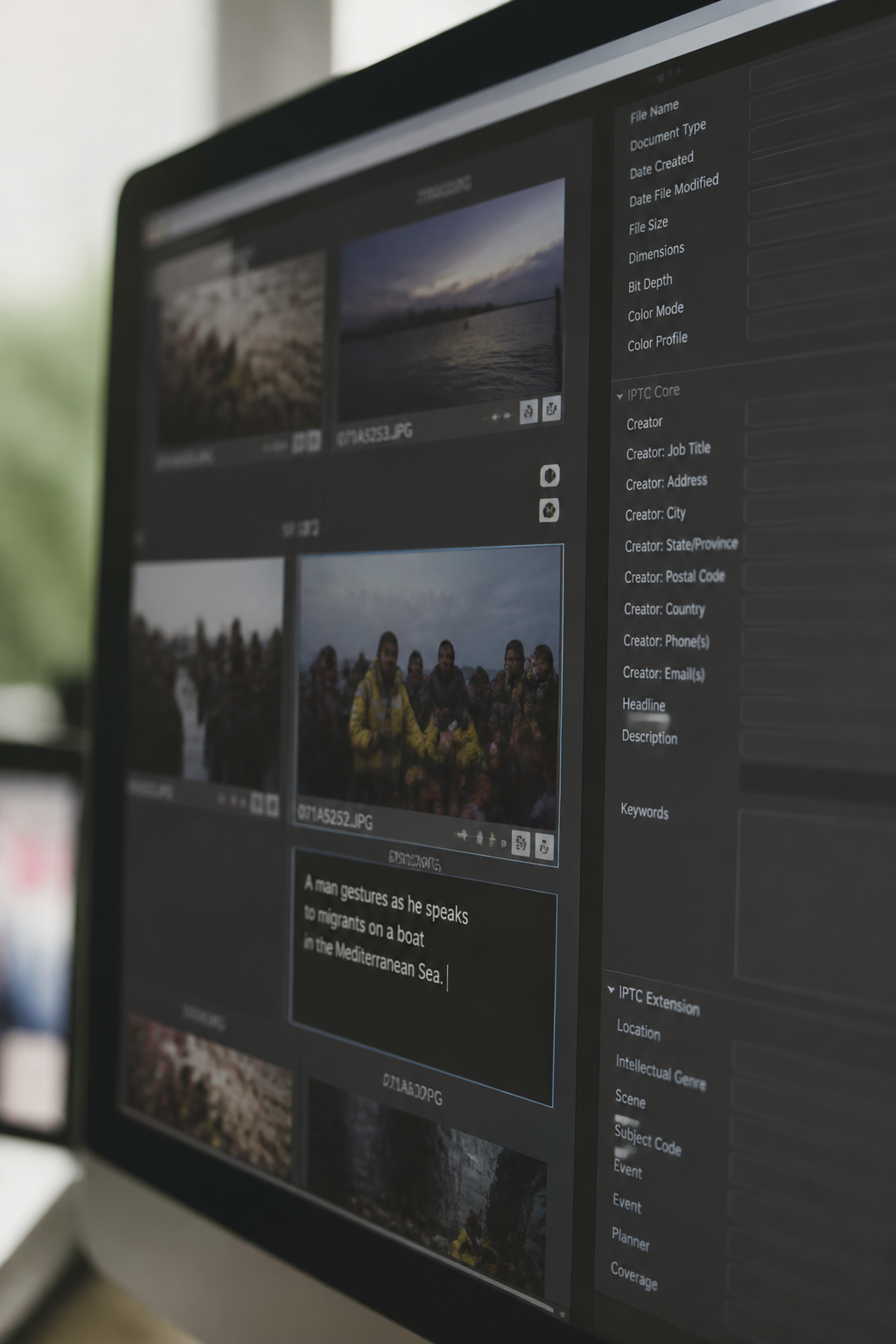
A licence you cannot prove is a licence you do not have. Two habits do most of the work: write the usage line into the metadata of the delivered files, and repeat that line word for word on the invoice. The metadata fields that carry it, and how they survive syndication, are set out on the page about wire credits and caption discipline.
The buyer's view of the same transaction, what the fee pays for and what the licence prices separately, is set out in the note on what a client actually buys.

The short version
You own the picture from the moment you take it. You sell permission, not property. Bound that permission on five axes, put the same sentence on the estimate, the delivery and the invoice, and register your work on a routine rather than after something goes wrong.