Photographing a mobile home park community without trespassing on it
One structural fact explains almost everything about these places, including why the pictures are so often condescending. The residents usually own their homes. They do not own the ground underneath them.
- Documentary
- California context
- Revised 20/08/2026
Split ownership, and why it decides the story
In the usual arrangement, a resident buys the home and rents the space it stands on from the park's owner. That single division produces the tensions that make these communities a serious documentary subject: the home is an asset, the ground under it is a monthly bill, and the two are controlled by different people.
It also explains why residents cannot simply leave when the rent on the space rises. Older homes frequently cannot survive being moved, transport is expensive, and in most regions there is nowhere to move to. Ownership of the structure, combined with no control of the land, produces a form of immobility that the phrase "mobile home" actively conceals.
Two words that are not synonyms
The federal construction standard for factory-built housing, generally known as the HUD Code, took effect on 15/06/1976. Units built to that standard are manufactured homes. Mobile home strictly describes units built before that date, though the older term survives everywhere, including in California statute, which uses "mobilehome" as one word.
The California legal frame, in the terms a photographer needs
You are not there to practise law, but a caption that gets the tenure wrong will be the thing readers remember. Four points cover most of it.
- The Mobilehome Residency Law, at California Civil Code section 798 and the sections that follow, governs the relationship between park management and homeowners who rent spaces. It is why the relationship is not an ordinary landlord and tenant one.
- The state Department of Housing and Community Development registers and titles manufactured homes and oversees park standards, although some cities and counties take on that enforcement role locally.
- Space rent stabilization exists in many California cities and counties through local ordinances. Whether a given park is covered is a local question, not a state one, and it is worth confirming before you write a caption about rent.
- Closure and conversion of a park triggers state planning requirements, including a report on the impact on displaced residents. When a park story becomes a news story, this is usually why.
Access: who you have to ask, and for what
The interior roads of a park are private. Walking them with a camera because they look like public streets is trespass, and being asked to leave once will close the whole place to you. Permission comes from two separate directions and neither substitutes for the other.
| What you want to photograph | Who grants it | Note |
|---|---|---|
| Interior roads, entrance, common areas | Park management or owner | Ask in writing. A short letter beats a phone call because it can be shown to a supervisor. |
| A resident, their home, their space, their garden | The resident | Management permission does not cover this and residents know it. |
| The community room, an association meeting | Whoever runs it, usually a residents' association | Ask at the meeting itself, at the start, out loud. |
| Minors | A parent or legal guardian, and the young person | See consent and releases. |
| The park from outside, from a public road | Nobody | Legal, and almost always the weakest picture available. |
A protocol that works
- Write to management first. Say what the project is, how long it will take, where the pictures may appear, and that residents will be asked individually.
- Find the residents' association before you find a subject. In an established park there is one, and it is the difference between being introduced and being reported.
- Knock. Do not photograph a home from the road and then ask afterwards; the order matters more than the outcome.
- Leave a card with a name and a phone number every single time, so that anyone can say no later. People change their minds and they are entitled to.
- Show people their frames on the back of the camera. It costs a minute and buys the next three visits.
- Come back with prints. Not as a gesture, as a debt. It is also how a second visit becomes a third.
The picture you can take on the first afternoon is the picture the place has already been shown as. Everything worth photographing is behind a door you have not been invited through yet.
The visual clichés, and what to do instead
Park stories fall into a small number of ruts, all of which use the residents as texture for an argument they were not consulted about.
- The single wide against a dramatic sky. Reads as a statement about poverty made by someone who did not go inside.
- Damaged skirting, broken toys, an abandoned chair. Present in every neighbourhood in the country. Selecting only these is editorialising with the lens.
- The long lens from the perimeter. Produces surveillance, and looks like it.
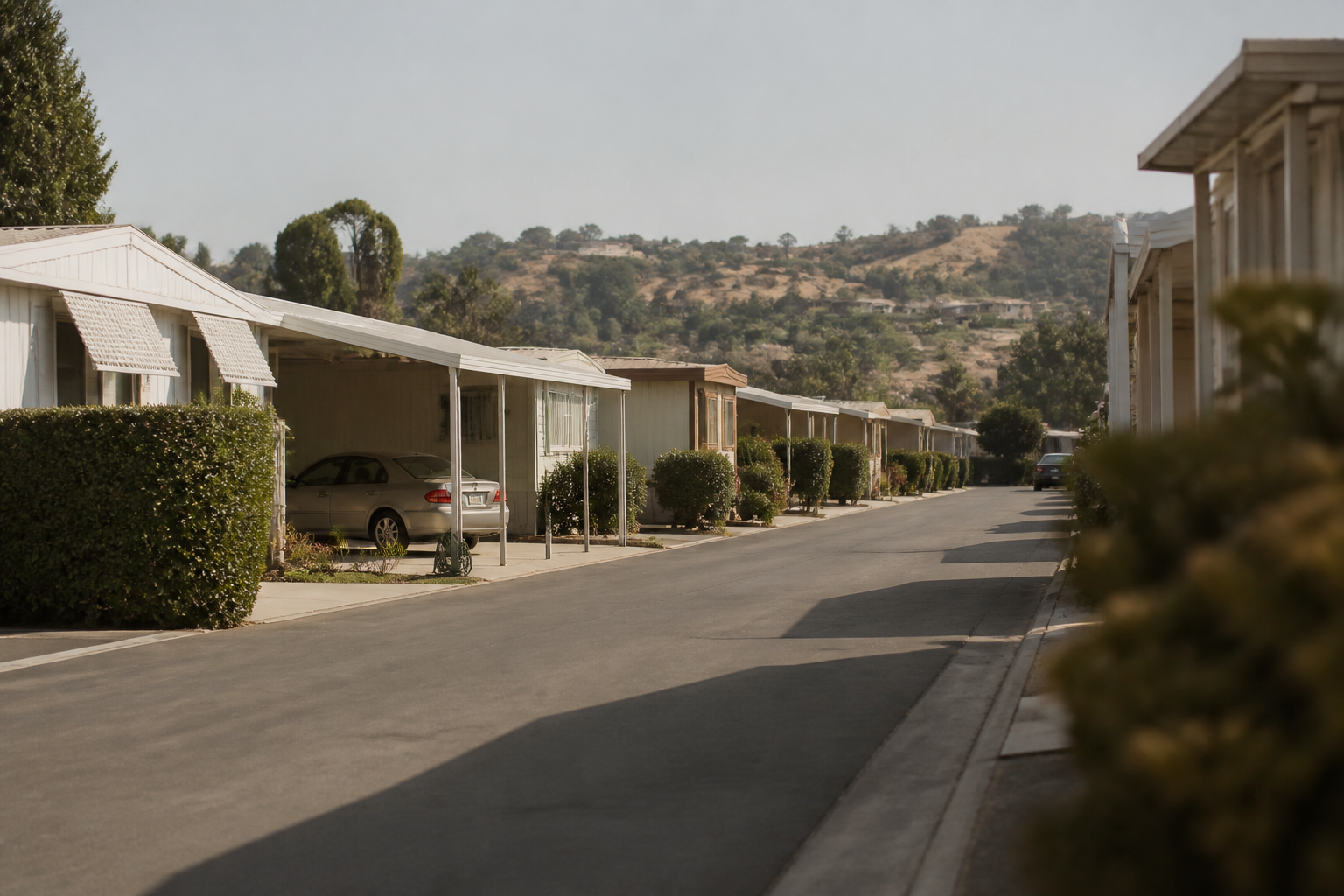
- The unpeopled street. Easy, safe, and says nothing except that you arrived at the wrong time of day.
The correction is not softer pictures. It is proximity, permission and time. A park is a community with a mail run, a maintenance schedule, a pool that may or may not still work, disputes, a barbecue, and people who have lived beside each other for twenty years. All of that is photographable and none of it is visible from a car.
The shot list, applied
Mapping the seven frames from the structure page onto this subject gives a concrete list you can work through on a second or third visit.
- Establishing
- The entrance and the sign, or an interior street with people in it. Not a drone frame: height removes the reader from the ground the story is about.
- Medium
- Maintenance, gardening, the mail cluster at the hour people collect from it, a home being re-levelled.
- Detail
- A hand-built ramp, a name plaque, a water meter, a repair made from what was available. These carry tenure and time better than any wide frame.
- Portrait
- On the steps or in the doorway, which is the threshold between what they own and what they rent. That is not symbolism, it is simply where people stand.
- Interaction
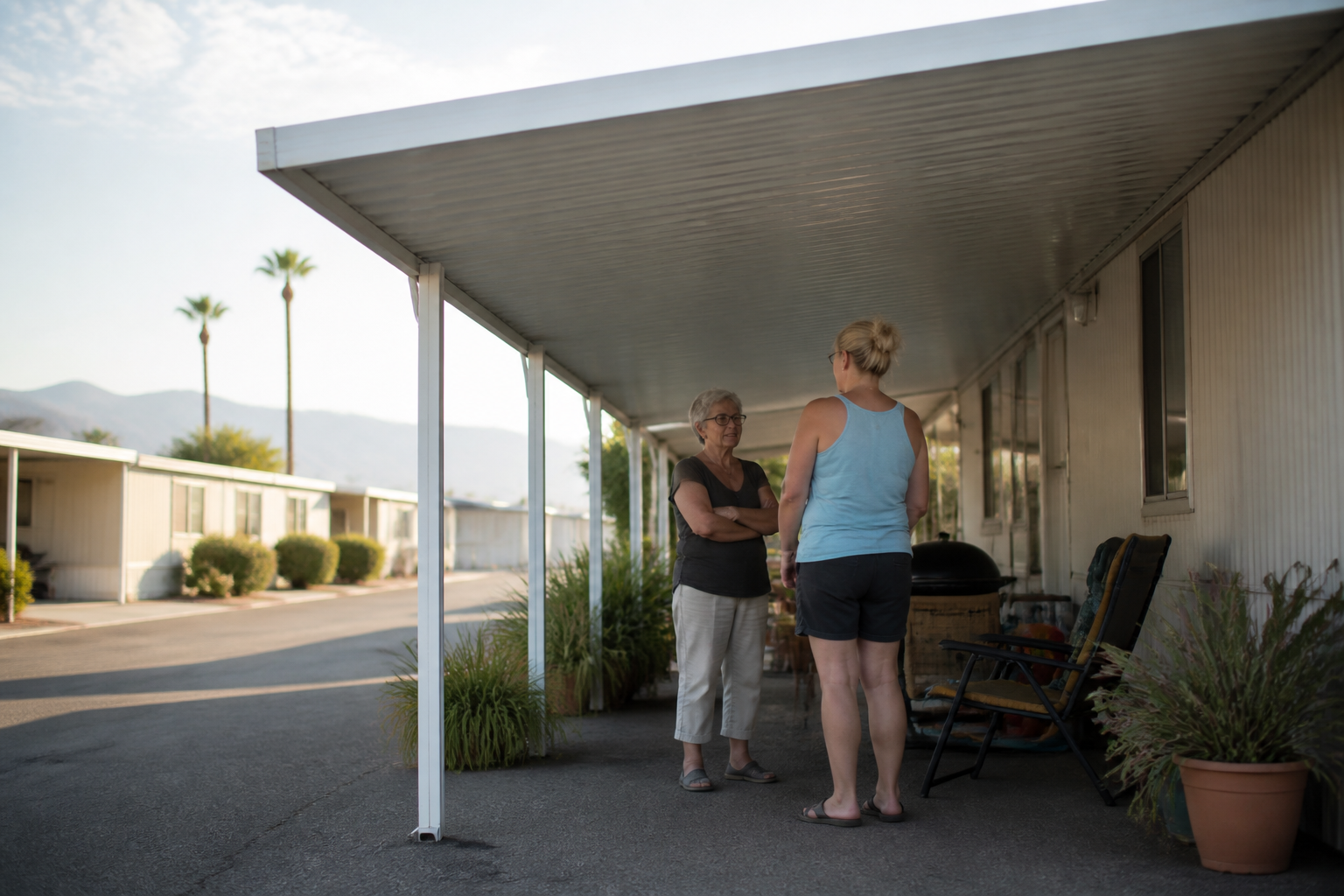
- Two neighbours under an awning. The association meeting. A dispute, if you have earned the right to be in the room.
- Signature
- Whatever frame contains both the home and the ground in the same picture. That is the story in one image.
- Closer
- Dusk, lights on, the street quiet. Ends the sequence without pretending the situation ended.
Captions
Get the tenure right and the rest follows. Say that a resident owns the home and rents the space, if that is the case, rather than calling them a tenant or a homeowner without qualification. Give the year the park was established if you can verify it. Do not put a rent figure in a caption unless a resident told you the figure and agreed to it being published; on the page about caption discipline there is a longer note on why speculation in captions is the fastest way to lose a subject's trust.
Where the subjects are animals rather than residents, the same patience applies at longer range: written records ahead of a wildlife shoot decide the watch point and the month before the lens is packed.