Wire credits, caption discipline and the metadata that carries your name
A photograph that leaves your machine badly captioned will be published badly captioned, corrected in public, or not published at all. Filing is not admin at the end of the job. It is the part of the job that determines whether the work counts.
- Assignment
- News and syndication
- Revised 20/08/2026
What a wire service is, and why it changes the credit
News agencies distribute reporting and pictures to subscribing outlets, so one photograph can appear in hundreds of publications in a day. The Associated Press, founded in 1846, is a not-for-profit cooperative owned by its member news organisations. Reuters, founded in London in 1851, and Agence France-Presse, whose lineage runs back to the Havas agency of 1835, work on commercial subscription models. Their standards differ in detail and agree completely on the essentials.
Because a wire image is republished by parties who never met the photographer, the credit line has to travel inside the file. It is not decoration; it is the only thing linking the work to the person who made it three publications downstream.
The shape of a credit line
Agencies use a consistent pattern: the agency identifier, a separator, then the photographer's name. Staff and contracted photographers are named. Where a contributor cannot be named, some agencies substitute an abbreviation for an unidentified stringer, and where a picture comes from an institution rather than a photographer, the supplying organisation appears instead.
Staff, stringer, contributor
- Staff photographer
- Employed by the agency or the publication. The employer normally owns the copyright as work made for hire, and assigns the work.
- Stringer
- A freelance who files on a per-assignment or per-event basis, often locally and often at short notice. Paid per job, not per week. Rights depend entirely on the contributor agreement signed at the start.
- Contributor or syndication
- An independent photographer whose existing work is distributed by an agency under a licence, usually with a revenue split. The photographer normally keeps copyright and grants distribution rights.
The one document worth reading closely in all three cases is the rights clause. What it does to your ownership is the subject of the page on licensing and usage.
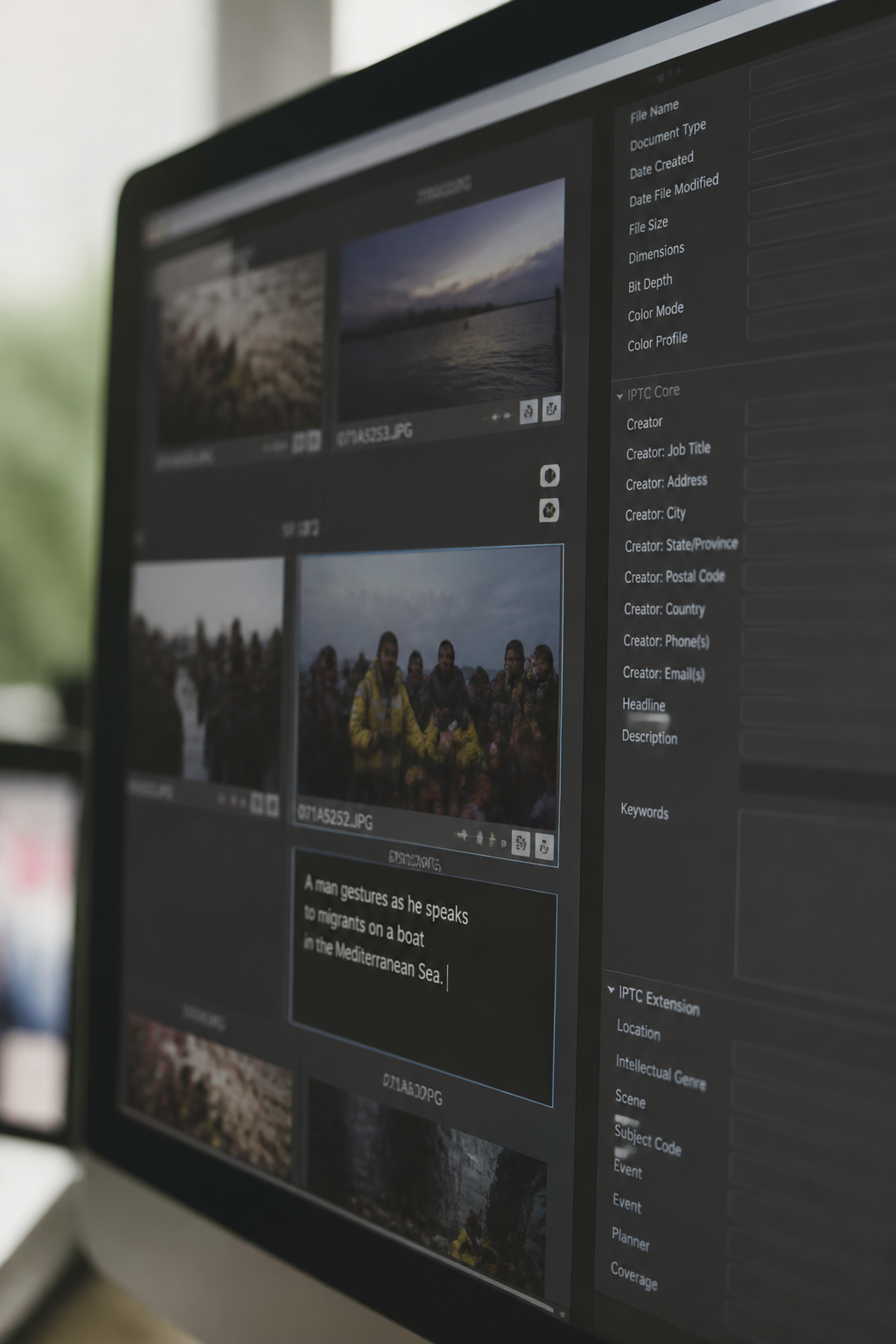
Writing a caption that survives a copy desk
News captions follow a stable convention because thousands of people have to parse them quickly and identically. The convention is worth learning even if you never file to a wire, because every picture editor recognises it and it forces you to check the facts while you still can.
- First sentence: the five Ws. Who is in the frame, what is happening, where, and when. Written in the present tense for the action, past tense for the date context.
- Second sentence: the context a reader needs and cannot see. Why this matters, or what preceded it.
- Identify people left to right, using the phrase "from left" so the desk does not have to guess.
- Spell names as the person spells them, confirmed with them, not from a badge you photographed.
- Date and place go in the caption, not only in the metadata. Metadata gets stripped. Caption text is usually retyped.
- Never speculate. If you do not know whether someone is a protester or a bystander, say what they are doing, not what they are.
If you would not be comfortable defending a word of the caption to the person in the frame, take the word out.
What you may and may not do to a news file
Photojournalism standards, including the National Press Photographers Association code of ethics and the standards published by the major agencies, draw the same line. Adjustments that a darkroom could always make are accepted; changes to content are not.
- Accepted: cropping, global exposure and contrast adjustment, colour balance, dust removal, converting to monochrome where disclosed.
- Not accepted: adding or removing any element, combining frames, moving anything within the frame, or altering colour so that it misrepresents the scene.
- Requires disclosure: any picture that was directed or set up rather than observed. Portraits are obviously directed; a "candid" that was arranged is not.
These rules apply to news and documentary work. They do not apply to advertising, which is why the two should never share a delivery folder.
The metadata fields that actually matter
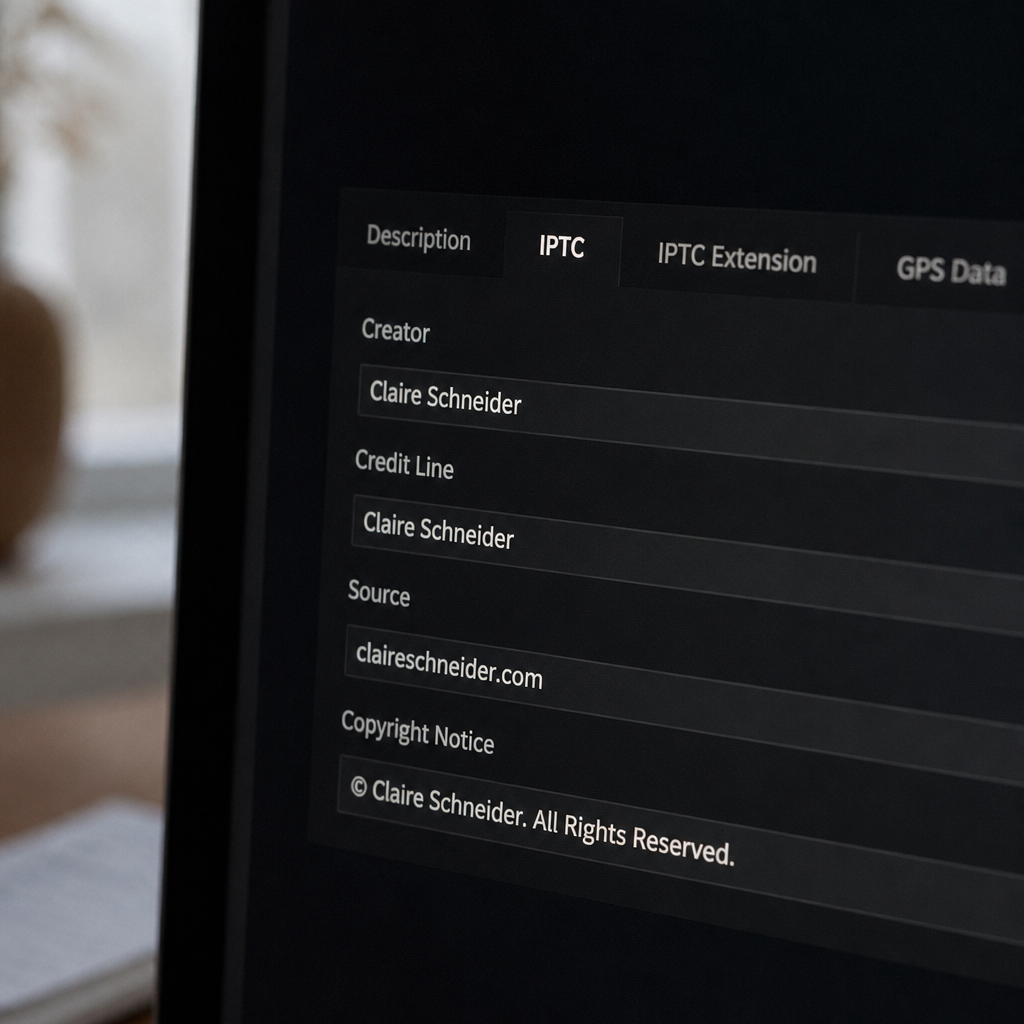
The IPTC photo metadata standard defines the fields that publishing systems read. Filling in eight of them takes about a minute per batch and is the difference between a file that can be traced and one that cannot.
| Field | What goes in it | Common error |
|---|---|---|
| Creator | The photographer's name, always the human being | Filled with a studio or agency name |
| Credit Line | Exactly how the publisher should print the credit | Left blank, so the desk invents one |
| Source | The party the file was obtained from | Duplicated from Creator, which breaks the chain |
| Description | The caption itself, full sentences | A filename or a list of keywords |
| Headline | A short label for the picture, not the article headline | Used as a second caption |
| Date Created | When the photograph was taken | Overwritten with the export date |
| City, State, Country | Where it was taken | Omitted, making the file unsearchable by desk staff |
| Copyright Notice and Rights Usage Terms | Ownership, and the licence granted in plain words | Left empty, so reuse looks unrestricted |
Metadata gets stripped, so plan for it
Resizing pipelines, content management systems and social platforms frequently discard embedded metadata. Treat the fields as a working system rather than a legal defence: keep an untouched delivery copy of every file you send, keep the delivery email, and register your work rather than relying on an embedded copyright notice to protect it.
The same discipline pays off in an ordinary portfolio, where files circulate without you. See the note at the end of editing a portfolio on exporting with the metadata intact.