Reading an advertising brief before you quote on it
An agency brief is a pricing document pretending to be a creative one. Five lines in it decide the number at the bottom of your estimate, and only one of them is about photography.
- Assignment
- United States practice
- Revised 20/08/2026
Editorial and advertising photography look identical on a contact sheet and behave nothing alike on paper. The difference is that an advertising image is used to sell, which means two things follow automatically: everyone identifiable in it needs written permission, and the price depends on how far and how long the picture will travel. The first is covered on the page about consent and releases. The second is this page.
What a usable brief actually contains
A brief that cannot answer these has not been finished, and quoting against it is guesswork. Send the missing ones back as questions before you send a number.
- Deliverables. How many final images, in what aspect ratios, and for which placements. "A few options" is not a deliverable.
- Usage. Media, territory, term, exclusivity, and scale. See the table below.
- Talent. Professional models, real employees, or members of the public. Each carries a different release, a different fee and a different re-use liability.
- Locations. Studio, controlled location, or public space. Public space means permits and it means weather.
- Approvals. Who signs off, at what stage, and how many rounds of retouching are included.
- Schedule. Shoot dates, delivery date, and whether there is a hard air date that removes your ability to reschedule.
The usage line is the price
A day rate prices your time. A usage licence prices the value the client extracts from the image. Two jobs with identical shooting days can differ by an order of magnitude because one runs on a regional website for six months and the other runs on outdoor advertising, worldwide, in perpetuity.
| Variable | Question it answers | What happens if it is left blank |
|---|---|---|
| Media | Where does it run: print, digital, outdoor, packaging, point of sale, broadcast stills? | The client assumes all of them. |
| Territory | Which countries or regions? | Worldwide, by default, in the client's reading. |
| Term | For how long, from which start date? | Perpetuity, which is the single most expensive word in the document. |
| Exclusivity | Can the image be licensed to anyone else, and is the category locked? | Nothing is exclusive, and the client is annoyed when a competitor uses it. |
| Scale | Print run, impressions, number of sites, number of markets. | Unlimited, which makes the licence unpriceable after the fact. |
One sentence to keep
The usage line on your invoice must be word for word the usage line on your estimate. If the campaign grows, that is a new licence and a new number, not a favour.
Send the estimate with a numbered usage line, then carry that same number onto the invoice. One reference, one description, one amount, so the two documents can be read side by side without a phone call. Keep the accepted estimate, the purchase order and the delivery note in the same folder as the invoice, and log every payment against it. If the client goes quiet, that file is what a claim rests on. The routine is set out in more detail under invoice control and proof, and it takes an hour to put in place before the next brief.
Who is on the set, and who is paying for them
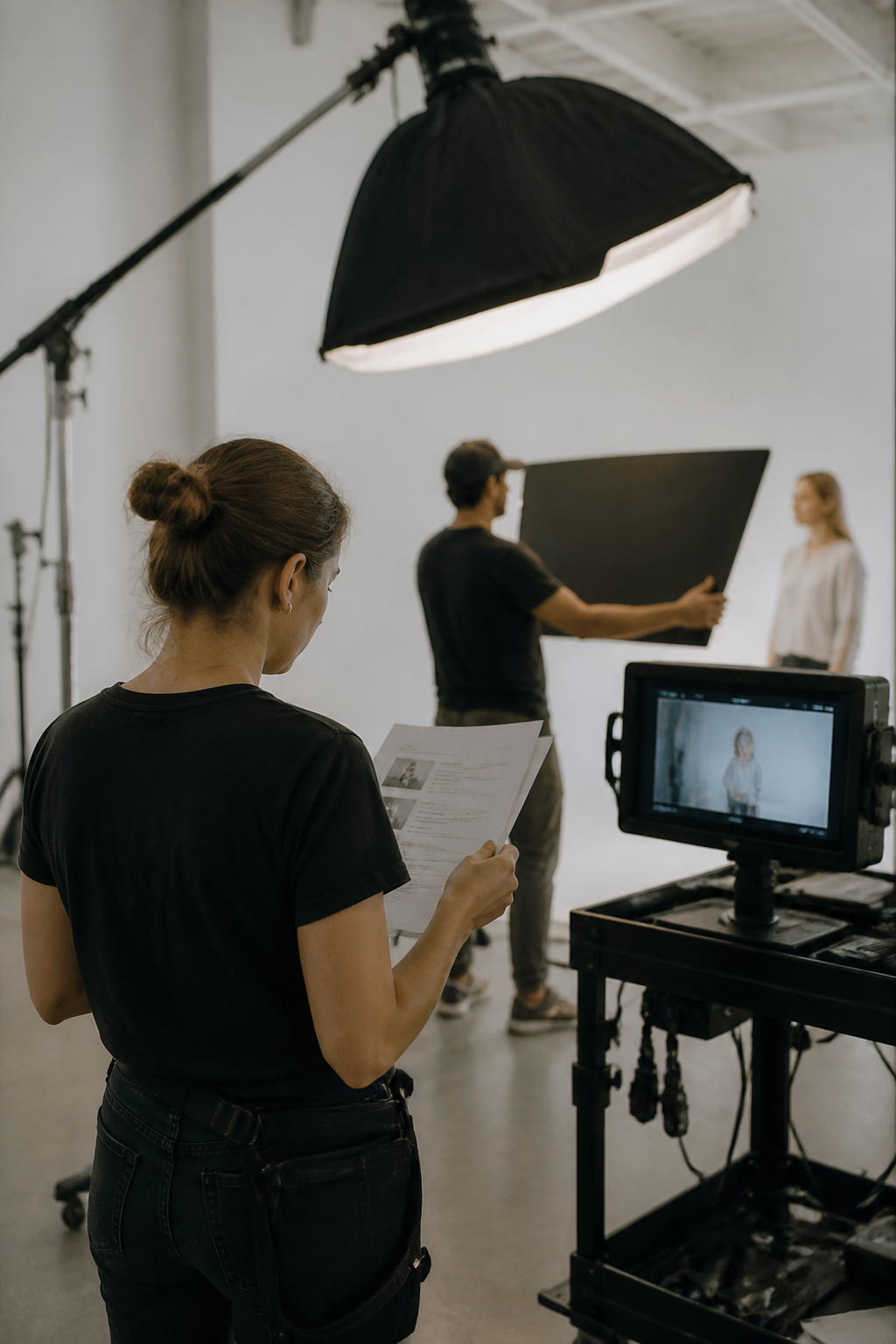
On an editorial shoot you are often alone. On a commercial shoot you are the head of a temporary department, and the estimate has to carry everyone in it.
- Art director
- Owns the creative intent and the layout. Decides whether the frame works for the design, including where the type goes.
- Art buyer or producer
- Owns the budget, the bidding and the paperwork. In practice this is who you negotiate with.
- First assistant
- Runs the floor: lighting, grip, safety, and keeping the shoot moving. On any set with modifiers above head height, not optional.
- Digital technician
- Capture, colour, backup and the tethered monitor the client watches. Also the person who guarantees the files exist in two places before anyone goes home.
- Stylists
- Wardrobe, prop, food or set, depending on the job. Their prep days are real days and belong in the estimate.
- Retoucher
- Post-production to final. Rounds of revision must be numbered in the estimate or they are infinite.
How the estimate is laid out
Keep fees and expenses in separate blocks. Fees are what you earn; expenses are what you spend on the client's behalf and pass through. Mixing them invites a negotiation on the wrong line.
- Creative fee, per shoot day, plus half or full rates for pre-production, travel and weather days.
- Licence fee, derived from the five variables above, stated separately.
- Crew, by role and by day, including prep and strike.
- Equipment, owned or rented, listed rather than lumped.
- Location, scouting, fees, permits, parking, power.
- Talent, fees plus usage for the people in the frame, which is negotiated on the same axes as your own licence.
- Post-production, with a stated number of revision rounds.
- Terms: advance before the shoot, payment period, and what happens on cancellation or postponement at various notice periods.
A cancellation clause is not pessimism. It is the only part of the estimate that protects the days you turned down to hold the date. Standard practice in commercial bidding

Copyright does not transfer by accident
In United States law, copyright vests in the author when the work is fixed in a tangible medium. For photographs that is the moment of capture. It stays with the photographer unless it is transferred, and a transfer of exclusive rights is only valid if it is in writing and signed by the person giving it up.
The phrase clients reach for is work made for hire. Under the Copyright Act it applies to work made by an employee within the scope of employment, or to specially commissioned work that both falls into one of nine enumerated categories and is covered by a signed written agreement saying so. A commissioned advertising photograph does not automatically qualify. If a contract asserts work made for hire, that is a request to give away the copyright, and it should be priced as one.
The related question, what a licence is actually made of and how registration changes your position if the image is misused, is set out on the page about licensing and usage.
Five questions to send back before you quote
- Where exactly will this run, in which countries, and for how long?
- Is exclusivity required, and does it lock the category or only the image?
- Who is in the frame, and who is obtaining their releases?
- How many final images, and how many rounds of retouching?
- Who signs off, and is there a hard air date that removes a weather day?
None of them is confrontational and all of them change the number. A client who cannot answer question one is not ready to buy.
How the two halves of that number get separated on the commissioner's side is worked through in the note on the day rate and the licence.